

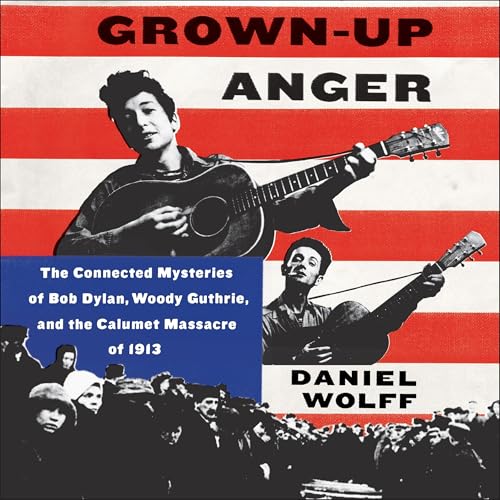
Grown-Up Anger
The Connected Mysteries of Bob Dylan, Woody Guthrie, and the Calumet Massacre of 1913
Échec de l'ajout au panier.
Échec de l'ajout à la liste d'envies.
Échec de la suppression de la liste d’envies.
Échec du suivi du balado
Ne plus suivre le balado a échoué
30 jours d'essai gratuit à Audible Standard

Grown-Up Anger
Acheter pour 36,30 $
-
Narrateur(s):
-
Dennis Boutsikaris
-
Auteur(s):
-
Daniel Wolff
À propos de cet audio
A tour de force of storytelling years in the making: a dual biography of two of the greatest songwriters, Bob Dylan and Woody Guthrie, that is also a murder mystery and a history of labor relations and socialism, big business and greed in twentieth-century America woven together in one epic saga that holds meaning for all working Americans today.
When thirteen-year-old Daniel Wolff first heard Bob Dylan s "Like a Rolling Stone," it ignited a life-long interest in understanding the rock poet s anger. When he later discovered "Song to Woody," Dylan s tribute to his hero, Woody Guthrie, Wolff believed he d uncovered one source of Dylan s rage. Sifting through Guthrie s recordings, Wolff found "1913 Massacre" a song which told the story of a union Christmas party during a strike in Calumet, Michigan, in 1913 that ended in horrific tragedy.
Following the trail from Dylan to Guthrie to an event that claimed the lives of seventy-four men, women, and children a century ago, Wolff found himself tracing the history of an anger that has been passed down for decades. From America s early industrialized days, an epic battle to determine the country s direction has been waged, pitting bosses against workers and big business against the labor movement. In Guthrie s eyes, the owners ultimately won; the 1913 Michigan tragedy was just one example of a larger lost history purposely distorted and buried in time.
In this magnificent cultural study, Wolff braids three disparate strands Calumet, Guthrie, and Dylan together to create a devastating revisionist history of twentieth-century America. Grown-Up Anger chronicles the struggles between the haves and have-nots, the impact changing labor relations had on industrial America, and the way two musicians used their fury to illuminate economic injustice and inspire change.