

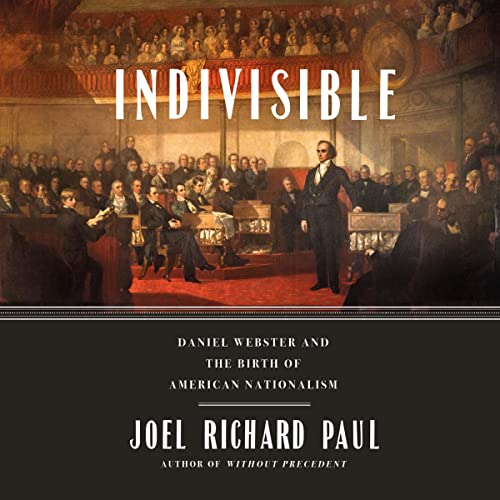
Indivisible
Daniel Webster and the Birth of American Nationalism
Échec de l'ajout au panier.
Veuillez réessayer plus tard
Échec de l'ajout à la liste d'envies.
Veuillez réessayer plus tard
Échec de la suppression de la liste d’envies.
Veuillez réessayer plus tard
Échec du suivi du balado
Ne plus suivre le balado a échoué
30 jours d'essai gratuit à Audible Standard
Choisissez 1 livre audio par mois dans notre collection contenant plus de 900 000 titres.
Écoutez les livres audio que vous avez sélectionnés tant que vous êtes membre.
Profitez d’un accès illimité à des balados incontournables.
L'abonnement Standard se renouvelle automatiquement au tarif de 8,99 $/mois + taxes applicables après 30 jours. Annulation possible à tout moment.

Indivisible
Narrateur(s):
Fred Sanders
Acheter pour 34,87 $
-
Narrateur(s):
-
Fred Sanders
-
Auteur(s):
-
Joel Richard Paul
À propos de cet audio
When the United States was founded in 1776, its citizens didn’t think of themselves as “Americans.” They were New Yorkers or Virginians or Pennsylvanians. It was decades later that the seeds of American nationalism—identifying with one’s own nation and supporting its broader interests—began to take root. But what kind of nationalism should Americans embrace? The state-focused and racist nationalism of Thomas Jefferson and Andrew Jackson? Or the belief that the U.S. Constitution made all Americans one nation, indivisible, which Daniel Webster and others espoused?
In Indivisible, historian and law professor Joel Richard Paul tells the fascinating story of how Webster, a young New Hampshire attorney turned politician, rose to national prominence through his powerful oratory and unwavering belief in the United States and captured the national imagination. In his speeches, on the floors of the House and Senate, in court, and as Secretary of State, Webster argued that the Constitution was not a compact made by states but an expression of the will of all Americans. As the greatest orator of his age, Webster saw his speeches and writings published widely, and his stirring rhetoric convinced Americans to see themselves differently, as a nation bound together by a government of laws, not parochial interests. As these ideas took root, they influenced future leaders, among them Abraham Lincoln, who drew on them to hold the nation together during the Civil War.
As he did in Without Precedent and Unlikely Allies, Joel Richard Paul has written in Indivisible both a compelling history and a fascinating account of one of the founders of our national perspective.
Pas encore de commentaire