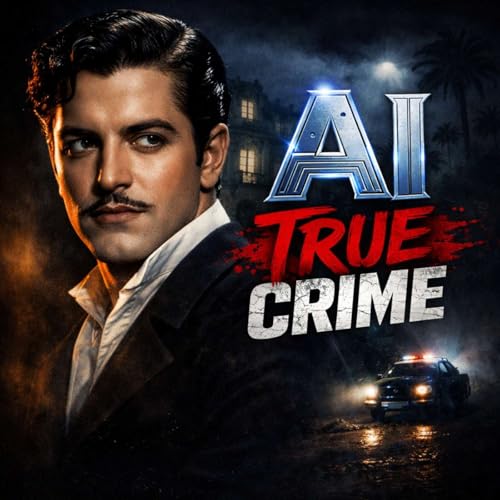
AI True Crime: The Murder of Ramón Novarro
Ramón Novarro was one of the biggest stars of silent Hollywood, a Mexican-born actor whose rise to fame made him one of MGM’s defining leading men of the 1920s. Best known for Ben-Hur in 1925, Novarro was marketed as a romantic screen idol and, after Rudolph Valentino’s death, was pushed even further into that image by the studio system. Behind that carefully managed public persona was a far more complicated life, one shaped by old Hollywood secrecy, pressure, and the dangers of living privately in a culture that demanded silence.
In this episode of AI True Crime, we examine the life, career, and murder of Ramón Novarro, tracing his journey from Durango, Mexico, to international film stardom in Los Angeles. We look at how Novarro became one of early Hollywood’s major stars, why Ben-Hur mattered so much to his legacy, and how the coming of sound altered the trajectory of his career. We also explore the way later generations remembered him less for his artistry than for the horrifying crime that ended his life.
The Ramón Novarro murder remains one of the most disturbing old Hollywood true crime cases because it sits at the intersection of celebrity, violence, and myth. Novarro was murdered in Los Angeles in 1968, and the brutality of the attack helped turn the case into part of Hollywood’s darker folklore. But the real story is bigger than tabloid memory. This is not only the story of a murdered silent film star. It is also the story of how Hollywood manufactured identity, how fame fades, and how a victim’s life can be reduced to a final sensational headline.
If you’ve searched for Ramón Novarro biography, Ramón Novarro murder, Ramón Novarro Ben-Hur, or old Hollywood murder cases, this episode is for you. We cover the historical Ramón Novarro, the star persona MGM built around him, the violence of his death, and the long shadow that murder cast over his legacy. This is classic Hollywood true crime with the full context the story deserves.
SEO Keywords:Ramón NovarroRamon Novarro murderRamón Novarro biographyRamon Novarro Ben-Hursilent film star murderedold Hollywood true crimeclassic Hollywood murderMGM silent starMexican born Hollywood stargay stars in old HollywoodHollywood scandal historycelebrity murder case
Episode Tags:AI True Crime, Ramón Novarro, Ramon Novarro murder, Ben-Hur 1925, silent film, silent movie star, old Hollywood, classic Hollywood, true crime podcast, celebrity murder, MGM, film history, Hollywood history, LGBTQ history, queer Hollywood
Meta Description:The murder of Ramón Novarro is one of the most infamous old Hollywood true crime cases. This episode explores the silent film star’s rise to fame, his role in Ben-Hur, and the brutal 1968 killing that reshaped his legacy.
Sources:
Encyclopaedia Britannica, “Ramón Novarro”https://www.britannica.com/biography/Ramon-Novarro
Turner Classic Movies, “Ramon Novarro Profile”https://www.tcm.com/articles/636685/ramon-novarro-profile-ramon-novarro
Turner Classic Movies, “The Cat and the Fiddle”https://www.tcm.com/articles/636698/the-cat-and-the-fiddle
American Film Institute Catalog, Ben-Hur (1925)https://catalog.afi.com/Catalog/moviedetails/2811
Encyclopaedia Britannica, “Ben-Hur”https://www.britannica.com/topic/Ben-Hur-film-by-Niblo
Turner Classic Movies, Ben-Hur: A Tale of the Christhttps://www.tcm.com/watchtcm/titles/35
This podcast is powered by Pinecast.


 Apr 27 202643 min
 Apr 13 202627 min
 Apr 6 202633 min
 Mar 30 202632 min
 Mar 23 202645 min
 Mar 16 202645 min
 Mar 9 202638 min
 Mar 2 202632 min