OFFRE D'UNE DURÉE LIMITÉE | Obtenez 3 mois à 0.99 $ par mois

14.95 $/mois par la suite. Des conditions s'appliquent.
Page de couverture de The Conversation Art Podcast

The Conversation Art Podcast

The Conversation Art Podcast

Auteur(s): Michael Shaw
Écouter gratuitement

À propos de cet audio

A podcast that goes behind the scenes and between the lines of the contemporary art worlds, through conversations with artists, dealers, curators, and collectors--based in Los Angeles, but reaching nationally and internationally. Art
Épisodes
  • Episode 382: Robbie Conal,from the studio to the streets--applying what you do best to what you care about most
    Dec 13 2025

    Artist and legendary street artist Robbie Conal talks about:

    His family history, including his two activist-and-politically inclined parents, his background in fighting the power; moving up to Los Osos (in San Luis Obispo County) as a permanent residence (back after the 2008 crash), but keeping a small place in L.A.; what he misses about not being in the city (he's lived in NYC and SF as well as L.A.); his first big moment with public art, through postering, which was born out of caricature paintings he was making of Ronald Reagan's cabinet, which he dubbed 'Men with No Lips,' and alighted through a large postering campaign just as Museum of Contemporary Art, Los Angeles, was opening to the public in 1986; how he's Shepard Fairey's OG, and how he was an influence on him as a future street artist (though Fairey said, "I can do that" quite confidently); his personal mantra: "apply what you do best to what you care about most," which in his case his drawing and talking smack (does best) and American democracy (cares about most); how, to make his work quicker to keep his work temporal, he switched from oil painting to charcoal and then to acrylic with oil accents; how all his friends who have his art (mostly of terrible characters) have them in their toilets; and his most popular work, "Watching, Waiting and Dreaming," a triptych of Gandhi, the Dahli Lama and Martin Luther King.

    This podcast relies on listener support; please consider becoming a Patreon supporter of the podcast, for as little as $1/month, here: https://www.patreon.com/theconversationpod

    In the 2nd half of the conversation, available to Patreon supporters, we talk about:

    How he's sustained himself financially over the decades outside of sales of his work, from teaching to receiving donations to his postering campaigns to lots of (young) volunteers; what he thinks about street art, and mural art, today, and the distinction between graffiti, street art and poster art, and how his reputation saved him from competing street artists when he was postering; our different respective takes on street art, and how Leon Trotsky taught him that everything is political, and street art is inherently political; what he's learned from terrible jobs: mainly, you can't make good art, let alone great art, in your spare time, while holding down a full-time job (and doing the work on the side); the most commonly asked questions he's received about postering (how many times have you been arrested?); how part of your mission as a poster is muscling up for the consequences; and what the best thing is to say to the judge when you're asked why you did it.

    And for the final 15 minutes of our talk, he covers the breadth of logistics related to putting up posters in public/on the street, which he refers to as 'acts of civil disobedience.'

    Voir plus Voir moins
    54 min
  • Episode 381- Arleene Correa Valencia: From rural Mexico to the Napa Valley and back, fulfilling a family dream
    Nov 15 2025

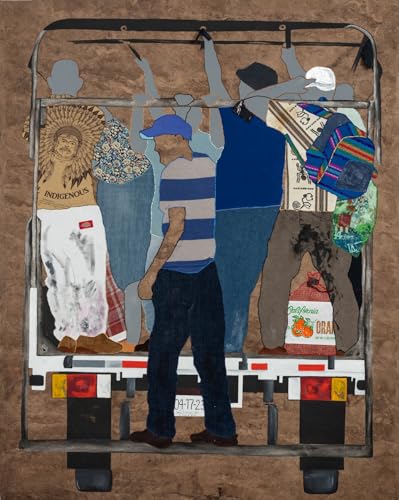
    Napa, CA-based artist Arleene Correa Valencia talks about:

    Why she lives in Napa, CA, and the two distinct versions of the town, for the wealthy and for the poor ("you're either the owner of the vineyard, or you're working the vineyard," as she put it); how she's the first generation to not be working the vineyards, his dad having worked the vineyard for a period before transitioning to hand-painting etched wine bottles for a winery (which he had to ultimately leave for lack of being paid enough because he didn't have an MFA); her favorite wines by grape (Pinots and Cabs from Sonoma mainly), and more recently a master fabricator color theorist and surface touch-up artist; making her dad's dreams to become an artist come to fruition through her; how she always refers to the work she makes as 'ours,' assuming everyone knows that her father always has a hand in the projects, in addition to consistently collaborating with makers from her culture of origin; the letters she exchanged with her father, while he was working to lay a foundation for the family to move to the U.S., among the artworks acquired by Stanford's Cantor Arts Center; her complicated DACA (Dreamer) status, and the exhibition she was able to have in Mexico (in Puebla, about 2 hours from Mexico City) which ultimately allowed her to apply for, and get, a green card; how she had to defer her dream to go to a 4-year university or art school until she received DACA status, and then she got a Diversity Scholarship that allowed her to attend California College of the Arts, which she would never otherwise would have been able to afford; how one of her 1st interviews was for someone interested in learning about being undocumented in the arts (originally published in Hyperallergic, she had to have it taken down for legal reasons to protect her); how her various supporters propelled her into her art-making and her art school education, and in turn the questions she asks herself about how she can help others, undocumented and otherwise…

    This podcast relies on listener support; please consider becoming a Patreon supporter of the podcast, for as little as $1/month, here: https://www.patreon.com/theconversationpod

    In the 2nd half of our conversation (available on Patreon), Arleene talks about:

    How her mom comes from a family with 36 brothers and sisters, so is part of an enormous extended family; the BRCA mutation in her family, in which bodies are much more susceptible to various cancers, including breast cancer and ovarian; why ICE hasn't been active in the Napa Valley area, very likely because people of wealth and/or power won't allow their wine supply to be affected; how aware she is of her career and her sales, and that she's proud of her production rate and the work her gallery is doing with her; the demand for her truck paintings, and why she has a need to make those paintings, not producing them for a paycheck; when she requested a collector give her more time to finish a piece that she wasn't happy with, and re-made it; how integral her dad is to her work and her process, and how he's celebrated along with her, if only through his tremendous pride in her, and that it wouldn't all happen without him; the work they do with a tattoo family, and how it's similar to the dynamic that she and her dad as a family do together, which she acknowledges is a bit like the man behind the curtain; her Tochtli (rabbit) tattoo, a symbol in her family that signifies selflessness and the ultimate sacrifice; how the evolution of her being tattooed, which started when she was 18, has been about honoring the story of her ancestry and claiming her identity, and how her brothers, like her, are acquiring full body suits of tattoos.

    Voir plus Voir moins
    54 min
  • Episode 380- London-based photographer and writer Michael Collins on the perils of photography, and art criticism, and why to give your viewers the benefit of the doubt
    Oct 11 2025

    London-based photographer and writer Michael Collins talks about:

    The flat where he's lived for 35 years, which is getting 'Wallace & Gromit' crowded; how he keeps film in his deep freeze (aka freezer) as opposed to anything edible, and how he's happy to shop for the day, while he points out that Brits see American refrigerators and are overwhelmed by how large they are; and by the way, we're also bludgeoned by advertising here, compared with the UK and Europe; how he sees our social media consumption as giving in to the impulsive at the expense of the rational, a battle he gives in to daily for a half hour on IG…and how sometimes, you just want to look at a panda falling out of a tree; why readers (of books) make better viewers of artworks; how when his photographs are printed at full scale (4 x 5 feet) you can walk into them and how part of photography's schtick is that it's nosy, that it admits everything in it; his takeaways from giving a presentation at the Hampstead Photographic Society, in which have the members bolted for the door at the break; the importance of 19th century photography to understanding the history of photography, and how it's not shown enough in museums (at least in London); how he started studying politics, but switched over to art, initially stumbling into photography as an editor at a teenage girl's magazine, then moving to The Observer, and then he became picture editor at the Daily Telegraph, where he realized, amidst a more rushed editorial structure that went with predictable stock photographers, that the most interesting photography was not there to fulfill another's agenda, but in pursuit of independence, to fulfill its own agenda.

    This podcast relies on listener support; please consider becoming a Patreon supporter of the podcast, for as little as $1/month, here: https://www.patreon.com/theconversationpod

    In the 2nd half of our conversation (available on Patreon), Michael talks about:

    The challenges of evolving and following your own path at the expense of taking the more marketable route, which means maintaining your integrity, and how his photographs, and his writing are both better than ever; the complex and fulfilling experience he had visiting and re-visiting a Jeff Wall museum exhibition; how the photographer Martin Parr dominates the scene in Britain, and how all his pictures look roughly the same, and yet he's kind of this hero in the country, through the 'steamroll of publicity,' and how there's far more depth, wealth and nuance out there than we're being allowed…; his first art review (for The Daily Telegraph), of Andreas Gursky's exhibition at Tate Liverpool, which uncovered a surprising digital edit, one he was turned on to by one of the museum custodians, and when he wrote the review that included his misgivings about the work, the Tate press office told him he was being cruel (to which he replied, "that's not being cruel, that's being honest"), and how another artist's agent threatened to sue for a negative review; our respective takes on art writing and criticism, in terms of what he appreciates vs. can't tolerate, and what I appreciate and can't tolerate; more about the world of magazine editing, which he describes as being a lifetime ago…; and finally, to wind down our conversation, we talk about his book, Blind Corners, which features several essays exploring across the spectrum of photography and photography's history; in particular we review a passage where he compares Americana via Kodachrome and Hollywood light with the dull, austere light of Britain, and he goes on to call out Dubai as the culmination of late capitalism.

    Voir plus Voir moins
    57 min
Pas encore de commentaire