Épisodes

  • A Spirited Conversation about Rowling-Galbraith's Cormoran Strike Series and C. S. Lewis' 'Till We Have Faces'
    Apr 19 2026
    [Apologies but the recording is quite poor at the start, but improves. Please bear with it - Nick]John Granger shared privately with Nick Jeffery that he thought it would be a good idea to read C. S. Lewis’ Till We Have Faces, a re-telling of the Cupid and Psyche myth, to get a better grip on Rowling-Galbraith’s re-imagining of the same myth in her Cormoran Strike series.Nick, as is his wont, promptly read the book, wrote up the possible connections between the chapters of Till We Have Faces and the books in the Strike series — C. S. Lewis’ ‘Till We Have Faces’ and Rowling-Galbraith’s Cormoran Strike Series (Part One) — which ‘Part One’ constituted a challenge to John to write up his contrarian notes as ‘Part Two,’ which he did yesterday.Today? They talk about CSL’s Till We Have Faces, what it tells us (and doesn’t tell us) about JKR’s Strike series, and the reasons why a Serious Striker or ‘every thoughtful reader’ really should read Lewis’ last novel, one he and Tolkien thought was his best.Hogwarts Professor is a reader-supported publication. To receive new posts and support my work, consider becoming a free or paid subscriber.Links to everything they discuss can be found in their respective write-ups: C. S. Lewis’ ‘Till We Have Faces’ and Rowling-Galbraith’s Cormoran Strike Series (Part One) by Nick and C. S. Lewis’ ‘Till We Have Faces’ and Rowling-Galbraith’s Cormoran Strike Series (Part Two) from John.Here is a copy of the ten questions that kept their conversation — for the most part! — between the guard rails. Enjoy!CSL and JKR Tackle ‘Cupid and Psyche:’ The Ten Questions1. (Nick) So, why, John, are we talking about a book Rowling has never mentioned, in a genre she has never attempted, by an author from whom she has tried to distance herself, and which has no obvious connection to what Rowling is writing today? [See the first paragraphs of John’s Part Two.]2. (John) Can you give our listeners a quick review of the book’s history, Nick, that is, the story behind the story? [Nick discusses information here not in either of their posts!]3. (Nick) Which is all very interesting from the Lake side of the reading, but it’s the story itself that is the connection to Rowling. Give us the plot points, structure highlights, and spoil the ending, too, won’t you, John? [John reads Nick’s plot summary from his Part One (below). Another summary can be found on the Faces wikipedia page.]Till We Have Faces: A Myth Retold by C.S. Lewis is a first-person retelling of the Cupid and Psyche myth, narrated by Orual, the eldest daughter of the King of Glome (a fictional barbarian kingdom). Orual frames Part One as a bitter complaint or accusation against the gods, particularly Ungit (a cruel fertility goddess akin to Aphrodite/Venus, represented by a black stone) and her son, the god of the Grey Mountain (the “Shadowbrute” or Brute). She writes in old age as queen, claiming the gods have wronged her, especially by taking her beloved half-sister Istra (whom she calls Psyche). The novel is divided into two parts. Part One (the bulk of the book, spanning 21 chapters) recounts events from Orual’s perspective as she experiences them, portraying her actions as justified love and the gods as unjust. Part Two (a short addendum of about 4 chapter) is written later, as Orual nears death. Here, she gains new insight through dreams, visions, and self-reflection, realizing how her “love” was often possessive, jealous, and devouring—much like Ungit’s. The veil she wears becomes a central symbol: initially to hide her ugliness, later as a barrier to truth and self-knowledge. “Till we have faces” suggests that true self-revelation and honest relationship (with gods or others) require facing reality without masks or illusions.4. (John) We know for sure that CSL was re-telling the Cupid and Psyche myth here; Lewis and the text make that undeniable. I argued from the text five years ago that Rowling-Galbraith was doing something similar and she suggested strongly by tweet this was the case. In your post, Nick, you swung for the fences to explore the possibility that Till We Have Faces was a model of sorts for the Strike series. Did you establish or eliminate that possibility -- and what were the most interesting connections you found? [See Part One!]5. (Nick) You’ve recently re-read this, too, John; were you struck by story echoes in Strike from Faces? [John discusses CSL’s wonderful cryptonyms, several of which have alchemical notes, a point he didn’t write up in Part Two, and then talks about the allusion to Psyche as “Artemis and Aphrodite combined” in Faces, the importance of ‘The Real’ in Lewis and Rowling, and the importance of “the riddle” to Lewis and a “debate” to Rowling, all in Part Two.]6. (John) The key connection, though, of course, is in the use of the myth and how the modern and postmodern authors parallel the ...
    Voir plus Voir moins
    1 h et 47 min
  • Metallurgical, Literary, and Psychological Alchemy: Is Jung a Good Guide for Understanding J. K. Rowling's Artistry and Meaning?
    Apr 2 2026
    This is the second of a series of posts about the literary alchemy of J. K. Rowling, a discussion jumpstarted by a post by ‘Iris’ at a Strike fan website, an article that championed a Jungian perspective on this subject. The first post in this series, Literary Alchemy – A Primer for Those Interested in J. K. Rowling’s Artistry, both explained what the ‘Iris’ post asserted and reviewed much of the critical literature that the brevity of the S&E Files article prevented her from discussing. See that post for links to this material. The conversation between Nick Jeffery and John Granger above was recorded in the same spirit as the first post was written, namely, simultaneously a welcome to Strike fans and Rowling readers who have learned about literary alchemy only recently and an introduction to the work of the last twenty five years on this subject. Upcoming posts in the series will include a counter-point discussion in the debate Rowling is fostering about whether a psychological or spiritual perspective is better for understanding art and life and a review of the alchemical signatures that crowd Rowling-Galbraith’s Hallmarked Man.This post is largely links to sources for points Nick and John discuss in their naturally enthusiastic and contrarian conversation, question by question. Enjoy!1. Welcome to the Conversation! (Nick) I just sent out an article about literary alchemy, John, in response to an article written by ‘Iris’ and posted on the Strike-Ellacott Files website, a piece titled ‘What is Literary Alchemy? Spotting symbols that map Strike and Robin’s growth.’ What advice or guidance would you give to, say, Cormoran Strike readers who are brand new to the subject? * There are three types of alchemy and it is important to understand the common ground they share and the differences between them;* The first type is alchemy proper, which is to say ‘metallurgical alchemy,’ the sacred science of purifying metals and the adept’s soul via the creation of a Philosopher’s Stone that will transform lead to gold and exude an elixir of life, the drinking of which will bestow immortality;* The second and third types of alchemy derive from interpretations of metallurgical alchemy’s aims and the symbolic texts detailing the work in the hermetic laboratory;* Literary alchemy is the use of metallurgical alchemy’s language, colors, sequences, and symbols in plays, poetry, and story to foster an edifying and transformative experience in the artist’s theater or reading audience;* Psychological alchemy is Carl Jung’s use of metallurgical alchemy’s texts during and after WWII to illustrate his ideas of the integration of the conscious and unconscious aspects of the human mind;* Metallurgical alchemy was practiced in China, the Levant, India, and Europe within the revealed religious traditions of Hinduism, Buddhism, Judaism, Islam, and Christianity until its degeneration in the late Medieval period and eventual evolution into the strictly materialist chemistry we know today;* Literary alchemy has been a continuous stream in literature from Dante, Chaucer, Shakespeare, and the Metaphysical poets through to Dickens, Yeats, the Inklings, Joyce, Nabokov, and J. K. Rowling;* The academic study of “alchemy in literature” was the province of Baconian and allegorical readings of Shakespeare (cf., Beryl Pogson, Peter Dawkins, Martin Lings) until the late 20th Century and the advent of academic specialists in ‘Hermetic Studies,’ e.g., Stanton Linden, Lyndy Abraham, and Charles Nicholl (cf., Cauda Pavonis: A Journal of Hermetic Studies, 1982-2000).* Jung and his followers used their psychological interpretations of metallurgical alchemy as allegories of the soul to interpret mythology (cf., Erich Neumann, Marie-Louise Von Franz, Robert Johnson);* Jungian analysis of story using Jung’s ideas of subconscious archetypes within a collective unconscious was popularized by Joseph Campbell in his guides to Joyce’s Ulysses and his more well known works on mythology (e.g., The Hero With a Thousand Faces);* ‘Isis’ in her S&E Files article, ‘What is Literary Alchemy?,’ suggests that Rowling-Galbraith is writing an allegory of soul transformation in the Cormoran Strike series using metallurgical alchemy’s symbols and sequences as understood by Carl Jung and his disciples rather than as used by English writers since the 13th Century;* It’s a challenging theory, the depth of which is hard to grasp without an appreciation of the types of alchemy, what they have in common, and their differences in approach and subject matter.2. The Lake: (John) What I found most fascinating in your post, Nick, was your best guesses about where Rowling would have learned about literary alchemy. She claimed in 1998 that she’d read a lot of alchemical texts from which she set the “magical parameters” of the Hogwarts Saga; if you had only three chances to name one of those books, what would you ...
    Voir plus Voir moins
    1 h et 44 min
  • What do Tyler Powell, Rupert Fleetwood, Jolanda Lindvall, and Lady Jensen Have in Common?
    Mar 2 2026
    Nick Jeffery and John Granger met up last Sunday — St David’s Day in Wales and the Sunday of the Triumph of Orthodoxy — to talk about John’s first Hallmarked Man names post, ‘The Allegorical Cryptonyms of The Hallmarked Man, Part One: Ten Cratylic Character Names and their Embedded Meanings.’ In addition to reviewing the high points of that post, Nick offered his insights about the first names John tried to decipher and John added context to the ‘Name Game’ Rowling Readers globally have been playing for 29 years now, Saturn return.Seven high spots of their rollicking conversation:* Nick shared his belief that Rowling creates the character names she does as much for herself as a writer as for her readers. If the character matches the name, as he sees it, then she has a constant reminder of what that imaginary man or woman does, says, or won’t do or say;* John pushed back on that, first because we’ve been told she changed character names while writing them, but more because of what a name is, namely, an image or icon through which the reader experiences the archetypal reference to which Rowling is referring. He thought this was complementary to Rowling’s other Shed tools (alchemy, mythology, ring writing, Christian symbolism, etc.) and argued that, as with the other anagogical artistry, our work in consciously excavating the hidden meaning of names was in keeping with the Hogwarts Professor corrective mission (Eliot’s "We had the experience but missed the meaning" challenge in The Dry Salvages);* Nick through light into John’s American blind spots with respect to Rupert (Army jargon! and a comic strip bear), Jensen (a posh car in the 60’s that had maintenance issues), and the Welsh undercurrents of Tyler, Griffiths, Ian (Ianto!), and Powell. And the River Fleet, a now invisible tributary channel flowing through the heart of London to the Thames!* John supplemented what he wrote in the post about the mythological backdrop to the Lindvall, Powell, and Griffiths names with what he thinks now are Christian symbolism, too, especially with respect to the love Tyler shows to Jolanda/Chloe;* John expanded, too, on Names being another Rowling method of “exteriorization,” a subject he covered at length in his ‘The Christmas Pig: A Quadrigal Reading’ in that epic post’s anagogical section, and the importance of that artistry in working the magic of transformation readers experience in her work;* Nick put John’s mind at ease about ‘Ian Griffiths,’ the name of Hallmarked Man’s sex trafficking, short, psychopathic rape-murderer, being a cipher for ‘John Granger;’ and * The two agree in conclusion, after an intense back and forth about the Peter-John Rule in Rowling Studies as applied to Strike 8, that the first ten names that John discussed in his post seem to confirm the Hogwarts Professor working-hypothesis that the last three books will be a trilogy involving many of the same characters to resolve unresolved questions and mysteries of the first seven book ring-set.John and Nick both referenced the work of Professor Beatrice Groves: check out her exegetical work on the name of The Silkworm’s ‘Owen Quine’ here, her post about Rowling’s connections with the ‘Never Forget’ Campbell clan, and her chapter on Cratylic Names in Literary Allusion in Harry Potter.Nick is working on another ‘Rowling Reading’ segment about a Hallmarked Man epigraph source, Matthew Arnold’s Merope: A Tragedy, John has more Strike 8 names in queue to decipher, most notably Danny DeLeon and Oliver Branfoot, John and Nick are both charting Part Nine of Hallmarked in which the meaning of names plays a critical role, and Nick is writing the itinerary for a bonus trip to Rowling’s home town that will be a bonus in the Hogwarts Professor online class in preparation. As always, thank you for your subscription to Hogwarts Professor as well as thanks in advance for sharing your thoughts in the comment boxes below. Stay tuned!Hogwarts Professor is a reader-supported publication. To receive new posts and support my work, consider becoming a free or paid subscriber. This is a public episode. If you'd like to discuss this with other subscribers or get access to bonus episodes, visit hogwartsprofessor.substack.com/subscribe
    Voir plus Voir moins
    1 h et 27 min
  • What the Hallmarked Man Epigraphs Reveal About Rowling-Galbraith's Artistry and Meaning
    Feb 22 2026
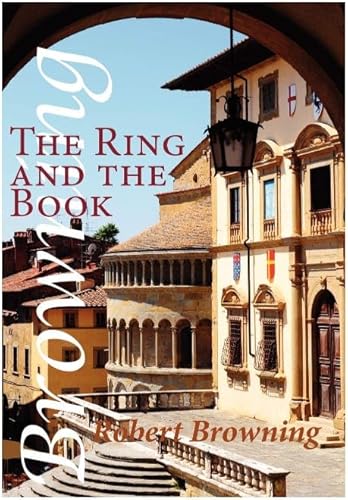
    Nick Jeffery read Robert Browning’s The Ring and the Book, a Victorian epic poem about a murder mystery in 17th Century Italy, to test a theory. John Granger’s best guess after surveying the chapter headings of Hallmarked Man last September was that, of all 77 sources for the 139 epigraphs in Strike8, Browning’s poem was the most likely to hold a secret message or special meaning inside it. John had said something similar about another Browning poem and Ink Black Heart, Elizabeth Barrett Browning’s Aurora Leigh, and Nick had confirmed that through his own reading and confirmation by Rowling herself. He thought John’s track record of spotting important epigraph sources merited a test reading.He published his findings on Friday in a post titled ‘The Ring and The Book – A Rowling Reading.’ In brief, the murder in Browning’s poem is a point-to-point model for the Ironbridge murder mystery in Hallmarked Man with characters in Rowling-Galbraith’s book — most notably, Chloe Griffiths, Tyler Powell, and Ian Griffiths — having their astonishing equivalents in Ring. The less obvious but more important links between the two are in their implicit feminism and other messages: Both works critique abusive relationships and patriarchal power: Guido’s control of Pompilia and Dino Longcaster’s control of Decima Mullins. The legal system (Books 8–9 especially) is satirized as formalistic, pedantic, and often blind to moral reality. True justice requires personal moral intuition beyond mere evidence or procedure. The Pope’s monologue (Book 10) weighs this tension most profoundly. In The Hallmarked Man the police are slow to act on new information gained by Strike and Robin and Farah Navabi manages to hoodwink the courts into escaping punishment for her part in Patterson’s crimes.The Ring and The Book dramatizes the eternal struggle between good and evil. Pompilia embodies instinctive purity, sacrificial love, and spiritual insight despite her suffering. Guido represents sophisticated, calculating evil that twists morality to justify cruelty. Browning affirms that evil exists but that good can somehow arise from or shine through evil’s consequences. In The Hallmarked Man evil is real, monstrous, and often cloaked in normalcy or power structures, but it can be exposed and defeated through persistence, intuition, and moral courage.Nick also discusses in this article the chiastic structure of Ring (!) and the ‘conversation’ he heard between Robert Browning in this poem with Aurora Leigh, the masterpiece by his late wife. His ‘Rowling Reading’ of Ring and the Book, consequently, will soon be a touchstone piece not only in Rowling Studies but Browning Studies as well (#ArmstrongBrowningLibraryAndMuseum @ Baylor). As they have done before with Nick’s ‘Rowling Reading’ articles. the Hogwarts Professor team recorded their conversation about the piece (listen to their discussions of I Capture the Castle and Aurora Leigh). Seven High Points of that Ring and the Book epigraph conversation include:* Nick’s review of why Serious Strikers and Rowling Readers should read The Ring and the Book along with the story of his immersion in it;* John’s explanation of why he was so confident that Browning’s poem was a template of some kind for Hallmarked Man even though only six of Strike8’s 139 epigraphs were taken from it;* Their survey of Rowling’s previous work with epigraphs — Deathly Hallows and Casual Vacancy all the way to Running Grave and Hallmarked Man — for works with similar embedded-in-the-epigraph texts and those without one (or in which it hasn’t yet been discovered);* Nick’s discussion of Rowling’s previous comments about epigraphs and her answer to the question, ‘Which Came First, the Epigraph or the Story?’;* John’s best guess pre-publication about the text that will be the epigraph source in Sleep Tight, Evangeline and which Strike text it will most resemble with its Whiskey Shambles title;* Nick’s commitment to exploring Blue Oyster Cult epigraphs in Career of Evil to see if one of that band’s albums, all of which supposedly had sci-fi themes and story continuity, served as a text-within-the-text for Strike3; and* John’s suggestion that the relationship of Elizabeth Barrett Browning and Robert Browning, a great love with a shared vocation, might be a point of reflection for Serious Strikers as a template for understanding the Strike-Ellacott partnership.Nick and John will be recording their group charting of Hallmarked Man’s Part Eight this week with Sandy Hope and Ed Shardlow (and Presvytera Lois?), a survey of readers is in the works, and the long-awaited close look at the Strike series in light of the Cupid and Psyche myth draws ever nearer. Stay tuned!The Ten Questions, Epigraph Charting, and Links to Previous Epigraph Discussions Here and Elsewhere:The Ring and The Book – A Rowling Reading, Nick Jeffery, February 2026Intro to Epigraphs ...
    Voir plus Voir moins
    1 h et 37 min
  • 'Sleep Tight, Evangeline,' Miniature Psalters, and the Head of Persephone: A Conversation with Dimitra Fimi
    Feb 17 2026
    Last November Nick and John introduced Dimitra Fimi, the magnificent maven of Tolkien Studies and Professor of Fantasy and Children's Literature at the University of Glasgow, to students of J. K. Rowling’s work. In that discussion, ‘Reading Rowling as Myth Maker and Myth Re-Writer: A Conversation with Dr Dimitra Fimi,’ she shared her thoughts about Rowling’s creative use of mythology in Harry Potter but especially in the Cormoran Strike series.The Hogwarts Professor team asked her to join us again because of Rowling’s yuletide charm bracelet gift to Strike fandom and the recent announcement of the Strike 9 title, Sleep Tight, Evangeline. Her insights about the Longfellow poem as a possible even likely source of the next book’s epigraphs are engaging, but it is her expertise in the arcane area of miniature books as well as mythology and the light each shines on the two items attached to the last link of the charm bracelet that open up exciting possibilities.Her idea is that the Psalter on the ninth link of the charm bracelet may actually be, unlike the other tokens on the bracelet’s nine links, an object that will play a part in the story, a miniature book. It turns out that one inch high books were something of an industry as curios in the 19th and early 20th century, a means of demonstrating technological mastery.Dr Fimi discussed several projects she has been a part of in conjunctions with nano-technologists and the librarians at the University of Glasgow’s special collections division. The one that has the most obvious link to English literature is the ‘Tiny Alice project,’ a contemporary effort to minituarize Lewis Carroll’s Alice stories to unfathomable minuteness:The Tiny Alice Project has produced one of the world’s smallest books: a tiny reproduction of Lewis Carroll’s children’s classic Alice’s Adventures in Wonderland (1865). All 78 pages and 26,764 words of the story have been transposed on to a tiny silicon chip, with each page just the width of a human hair (60 microns). Each individual letter is just two microns high, and made from pure gold!Click on the icons below to find out more about the project, the technology behind it, and Lewis Carroll and his interest in the minuscule. Via the tabs above you can also discover the long tradition of miniature books, and teaching resources.Clip: Twixter link to tweet aboveYou can read Dr Fimi’s write-up of ‘Tiny Alice’ and the Miniature Book exhibition she curated at the University of Glasgow to highlight their special collection of these treasures at her 2019 blog post about them. Pictures that include annotated miniature books — copies in which their owners made notes in the miniscule margins of the printed pages — can be seen here.Later this week, Nick will be sharing his thoughts on Robert Browning’s The Ring and the Book as the Ironbridge Murder story’s template within Hallmarked Man, John, Nick, Sandy Hope, and Ed Shardlow will be parsing the ring within Strike8’s Part Seven, and more about Longfellow’s Evangeline — stay tuned!The Ten Questions Guiding Today’s Conversation with Dr Fimi with the Necessary Links for Fun Follow-Up:(Intro) So everything Serious Strikers are thinking and talking about this month made me think of you, Dimitra, and to write you hat-in-hand with an invitation for your return to HogwartsProfessor to share your perspective, knowledge, and first impressions. Thank you for making time to join us!1. (John) Jumping right in, then, two of the charms on the Strike9 or ‘Evangeline’ bracelet are Fimi areas of unique expertise: the Psalter and the Head of Persephone. I had urged readers to read your Miniature Books in Children’s Fantasy at A Kind of Elvish Craft: The Dimitra Fimi Substack Site in the links after our conversation here last November but I confess to being surprised still when you asked for the dimensions of the Psalter charm after Nick and I posted our thoughts on the subject. For those who haven’t read your ‘Miniature Books’ post, please share how one of the world authorities on the writing of J. R. R. Tolkien became interested in the smallest of texts, the ‘Little Books’ of 19th century printing.2. (Nick) So you asked for the dimensions of the Psalter, you weren’t thinking as we were that the Psalter charms would be a box holding a folded up paper with a psalm, maybe two, inside it. You’re thinking it might actually be a complete Coverdale Psalter? Is that possible?3. (John) What Nick and I hope to contribute to the nascent field of Rowling Studies, as you know, is a refocusing of the scholarship and the serious reader attention about her work on to her Lake Springs -- the biographical part of story inspiration -- her Shed Tools or intentional artistry, and the Golden Threads, the plot points and themes that run throughout her work, i.e., to bring Rowling Studies more in line with all literary scholarship about notable authors, living and ...
    Voir plus Voir moins
    1 h et 23 min
  • Valentine's Day Special: The Cupid and Psyche Myth within the Cormoran Strike Series
    Feb 14 2026
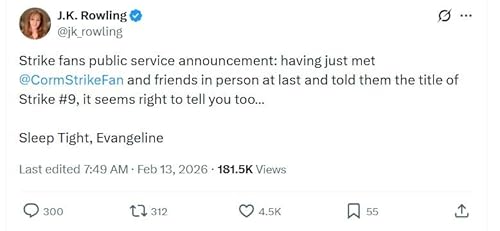
    Happy Valentine’s Day!Mrs Murray met the UK StrikeFans.com contingent and Badly WiredLamp (“and friends”) on Thursday to talk about the Cormoran Strike novels. Yesterday, Friday the 13th, Rowling tweeted about the secret she had told them — the title of Strike9:Nick Jeffery found the most likely source of the title Sleep Tight, Evangeline, assuming it is not an anagram, in six minutes:BadlyWiredLamp who was at the Rowling meeting congratulated Nick on twixter seven minutes later: “Well done for finding it Nick!” with a hand salute emoji. Which semi-confirmation from a witness suggests he is spot on.Even more impressive, Nick wrote up a flash post about The Whiskey Shambles and other ‘Evangeline’ possibilities at the HogwartsProfessor weblog, ‘Sleep Tight, Evangeline – Title Release for Strike 9.’ Nick and John will be discussing this news as well as the Psalter and Head of Persephone charms with miniature book, Tolkien, and mythology expert Dimitra Fimi this weekend for a post here next week. See her ‘Miniature Books in Children’s Fantasy’ to prepare for that conversation. Stay tuned!But it’s Valentine’s Day! John and Nick celebrate this Hallmark Holiday with a journey through the Cormoran Strike novels’ V-Day celebrations and a discussion of the various Valentines and Cupid’s in the story, with special emphasis on the Cupid and Psyche myth that Rowling has suggested is the series story template.That suggestion came the week after Hallmarked Man’s publication in the first of her Public Service Announcements to “Robin and Strike fans:”This image came as a surprise even to Hogwarts Professor subscribers because, though we have been writing and talking about the Cupid and Psyche myth as one of the mythological templates behind the Strike series since early 2021, it was the first time Rowling had acknowledged this publicly. Since the September revelation of this connection by the author and the appearance of the head of Persephone at the end of her Strike9 clues Christmas Charm bracelet, Strike fandom is now on board with the idea. Which on-boarding Nick and John celebrate with this Hearts and Flowers conversation, in which:* Nick reviews the Valentines Day events in the Strike series, the importance of which makes 14 February to Serious Strikers what Halloween is to Harry Potter fans;* John discusses the post American Bar office scene in Troubled Blood that let the cat out of the bag about the Cupid and Psyche myth just beneath the Strellacott romance;* Nick updates that with Rowling’s PSAs and charm pointers to the Trials of Psyche in Robin’s story;* John lays out how and where Hallmarked Man features Valentine Longcaster, the character with the Cupid name, and a Valentine’s Day conflict with dogs to Guard the Gates of Hell (from charting Parts Five and Six);* Nick journeys back to Cuckoo’s Calling and explains how Lula Landry’s death and Robin’s first meeting with Strike are twist on Cupid and Psyche with Venus, Psyche, and Cupid, Hephaestus, and Ares all with their equivalents in Charlotte, Robin, and Cormoran;* John ups the ante of the conversation by bringing in Edmund Spenser and C. S. Lewis, two writers Rowling loves, both of whom wrote stories that turn on Cupid and Psyche, and suggesting that Galbraith, in using the Eros-Anteros distinction of those writers in the Strike series is answering allegorically the core question of human life: whether to focus the soul on the ephemeral body and its desires or on the noetic faculty of soul, the Heart, logos within us;* Nick and John then discuss Robin and Strike’s individual relationships Cuckoo to Hallmarked in light of Cupid-False Cupid and taking turns going through the Strike novels with a look at the principal murder victim and murderer and their respective relationships;* John shares the Jungian interpretation of Cupid and Psyche as the mythic representation of feminine actualization, the chrysalis of female identity;* And more!Below are the links to posts on this subject mentioned in their back and forth and to a translation of the original myth. Happy Valentines Day — and stand by for more discussion of Sleep Tight, Evangeline, the Psalter and Persephone Charms, and all things Strike and Mythology with Dimitra Fimi.Links Mentioned in the Valentines Day Celebration Conversation:Rowling Points to Myth of Cupid and Psyche in order to Console Strike Fans Disappointed with Hallmarked Man (8 September 2025, Nick Jeffery)Nick shares the context of Rowling’s tweet (fan disappointment!) and the background information about the illustration she chose for it.The Most Pleasant and Delectable Tale of the Marriage of Cupid and Psyche (Apuleius)A translation of the Silver Age Latin tale from Apuleius’ Golden Ass.A Mythological Key to Cormoran Strike? The Myth of Eros, Psyche, and Venus (22 April 2021, John Granger)The first post to discuss Rowling’s use of this specific myth within Cormoran Strike,...
    Voir plus Voir moins
    1 h et 58 min
  • The Christmas Charm Bracelet of Strike 9 Clues (Part Two)
    Feb 6 2026
    Elizabeth Baird Hardy, Deputy Headmistress of Hogwarts Professor, the genius behind AppalachianInkling.com, Hunger Games expert, and author of Milton, Spenser and the Chronicles of Narnia: Literary Sources for the C.S. Lewis Novels, joined Nick and John to discuss the Charm Bracelet that J. K. Rowling posted on her Twixter home page as a Christmas gift to her readers. She said that that the thirteen charms on nine links were a set of clues about the next Strike novel, the ninth in a ten book series.In the first Part of Elizabeth, Nick, and John’s conversation, they discussed Rowling’s charm bracelet history, speculated about why she posted this picture when she did, decided to look at each charm on the bracelet for its stand-alone meaning and its place in the nine link set, and to read the whole series as if it were a ring composition, one reflecting a nine Part structure in Strike 9. They then made deep dives into the details of each charm: the heart shaped box containing a ‘You and Me’ engagement ring, a golden diamond-laden egg, a foul anchor, two angels, and a Trojan horse.In this second Part of that conversation, the trio of Serious Strikers continue with the remaining charms on the bracelet, namely, a Jack-in-the-box, an Hourglass, a White Rose and Crocodile, a Corvid head, and a Psalter paired on the last link with the Head of Persephone. They share their thoughts, too, about the bracelet as a symbolic integer and its ring meaning.The notes below are in support of references they make mid-flight and to other resources of interest to Magic Charm Decoders! Enjoy.Thank you to all our subscribers with special gratitude and appreciations for our paid subscribers; you are the wind in our sails, the heat from our vents… Serious Strikers are reading Browning’s The Ring and the Book, charting Hallmarked Man Part Six, and reviewing the Myth of Cupid and Psyche to look for parallels in the Strike-Ellacott series. See you soon!Jack-in-the-Box Charm* Rowling claims this as her favorite charm (Nick and John in the conversation mistakenly attribute this preference to the Psalter charm):* Badly Wired Lamp ID’d it* Is it a devil — or a Racoon?* The jack in the box toy, the 'Jack' being a devil, was invented in Germany in the 16th century as a mockery of the Roman Catholic doctrine of the Real Presence of Christ in the Eucharist. * The shape of this charm, the golden circular center in the inside of the open box top, represents the transcendent spiritual realm and the square bottom with its four directions, the fallen world. The ‘jack’ devil lives in the latter but is from the former.* The charm is the third latched object in the chain, the heart box and Trojan horse preceding it and the psalter at chain’s end following it — which means the ring latch and center are latched objects with surprises inside. The two interior objects at center have deadly surprises and the beginning and end eternal life interiors. The symbolism here is of the human being and its capacity via choice for either spiritual perfection in sacrificial love (anteros) or consumption by individual desires (eros). The thing hidden inside, man’s spiritual capacity or heart, is either light or darkness, the inside bigger than the outside. (John)* What is the Strike 9 connection, the analogue to the demonic Jack in the box? Is it RFM? Uncle Ted? Ilsa’s husband Nick? Polworth?* The Jack’s position is at the center of the bracelet and between the hourglass and the Trojan horse. So it’s placed between cleverness and craftiness and things that we can control and bad surprises, but also time, because we can’t control time. (Elizabeth)Hourglass Charm* tempus fugit ‘like sand in an hourglass’* memento mori* infinite symbol* The Strike series may be a collection of mystery-story genres, each one illustrating a unique type of story, different from all the others while keeping the same core of characters and overarching narrative (cf., Rowling’s note in The Running Grave acknowledgements that that book was her “cult” book). The hourglass, then, may be Rowling’s pointer to Strike9 being a suspense drama in which the good guys not only have a challenging mission (find and rescue the missing Robin, Strike, Lucy, Pat, whomever) but have to do it before a literal deadline arrives. The Ticking Clock plot device.* If the Jack at link five is the center of the bracelet ring of nine links, how does the hourglass mirror the Trojan horse? It’s two parts? The deadline aspect? “Reveal the crazies inside before the hourglass empties”?White Rose Charm* White Rose of Yorkshire* The interior of the flower charm is a literal Turtleback or ring composition diagram.* White Rose of Dante: Paradiso Cantos XXXI and XXXIIThe true home of all the blessed is with God in the Empyrean, a heaven of pure light beyond time and space. Dante sees the blessed systematically arranged in an immense white rose: like a hologram, a ...
    Voir plus Voir moins
    1 h et 10 min
  • The Christmas Charm Bracelet of Strike 9 Clues (Part One)
    Feb 4 2026
    On 23 December last year, Rowling changed her Twixter home page header and cameo with this tweeted explanation:The Charm Bracelet header features thirteen charms on nine links:Rowling tweeted an addendum about the Psalter and Jack in the Box charms:Nick Jeffery dropped an explanatory post two days later at the Hogwarts Professor weblog: J. K. Rowling Drops All the Strike 9 Clues for Christmas! It remains the only complete survey of the pieces and compendium of what Serious Strikers around the world have discovered about them.Beatrice Groves, author of Literary Allusion in Harry Potter, wrote up her charm bracelet thoughts at ‘The Strike Ellacott Files’ a month later. In ‘Charms, Psalms & Golden Clues: A brace(let) of clues for Strike 9,’ Prof Groves discusses the magical quality of charms as talismans and even incantational song:Rowling points out in this 2013 piece the link between the name given to charm bracelets and the magical world: ‘Why do we call those little masterpieces “charms” if not in allusion to their talismanic properties?… they are personal amulets.’ To charm someone is also to slightly to bewitch them, something Rowling plays with when Riddle exerts his charm on Ginny and literally possesses her: ‘If I say it myself, Harry, I’ve always been able to charm the people I needed.’ Witch Weekly’s Most-Charming-Smile Award is given to a smile that is both literally, as well as metaphorically, bewitching.The word ‘charm’ comes, through French, from the Latin ‘carmen’ which means ‘song, verse, oracular response, incantation.’ Its first meaning in English, therefore, was the magical one: ‘the chanting or recitation of a verse supposed to possess magic power or occult influence; incantation, enchantment; hence, any action, process, verse, sentence, word, or material thing, credited with such properties; a magic spell; a talisman, etc.’ (Oxford English Dictionary). From the sixteenth century onwards, ‘charm’ meant ‘anything worn about the person to avert evil or ensure prosperity’ because such amulets might contain the text of such a charm. And thinking about this made me aware for the first time of how in the most important charms in Harry Potter – the Fidelius Charm and the Patronus Charm – the word is not simply a synonym for spell but encodes this original, protective meaning. These magical ‘Charms’ like the charms on charm bracelets encode what Rowling calls ‘talismanic properties.’Nick and John invited Elizabeth Baird Hardy, Deputy Headmistress of Hogwarts Professor, the genius behind AppalachianInkling.com, Hunger Games expert, and author of Milton, Spenser and the Chronicles of Narnia: Literary Sources for the C.S. Lewis Novels to talk about these charms, especially about what she had written briefly on the subject. The goals of this conversation? * To introduce the subject to everyone not familiar with the Christmas tweets and bracelet-header, * to discuss the ‘Why?’ of this present to Strike fans everywhere, * to speculate about the meaning of the bracelet pieces individually and in a series, and * to brainstorm their qualities as clues for Strike9, the penultimate novel in the decalogy.Which is a lot! The good news is that the conversation never flagged and the revelations and possible meanings of the charms, thirteen in total on nine links, reward anyone listening in.Nick starts off the conversation with a review of the six charm bracelets in Rowling’s life and writing, one of which was a long forgotten piece in the margins of a Rowling web site:[You can read about those internet ‘Easter Eggs’ in ‘Hidden Photos at Rowling’s Website’ here, here, here, and here.]Nick offered as a guiding idea for our conversation the likelihood that the nine links in the bracelet were meaningful, i.e., that they reflected the structure of the book for which the bracelet is meant to be a clue. There are thirteen charms, he noted, but certainly Rowling-Galbraith could have had a thirteen link chain made if she hadn’t thought the nine links more than sufficient, even a pointer to Strike 9 being a nine Part mystery. Since, as Nick noted, she has trouble even passing up a shop selling charms, it seems likely she has been collecting the pieces for this one for some time. Perhaps this bracelet is a “target” toward which she has been writing with these books. It is certainly not something she just threw together for a header photo shoot. The trio elected to read the circular collection of charms, consequently, as pieces with individual meaning — as magical talismans of sorts per Prof Groves — and as a ring composition, with both aspects indicating the place and meaning of the piece in the book.After a brief discussion of why Rowling, Inc., would release this set of clues now, with another Strike novel or Bronte Studios television adaptation in the distant future — John offered the possibility that this bit of fan servicing...
    Voir plus Voir moins
    1 h et 22 min