

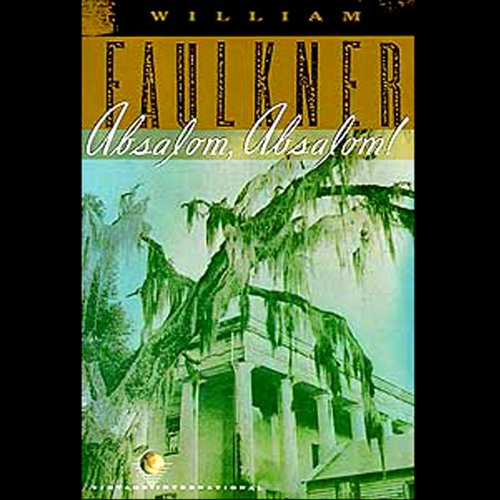
Absalom, Absalom!
Failed to add items
Sorry, we are unable to add the item because your shopping cart is already at capacity.
Add to Cart failed.
Please try again later
Add to Wish List failed.
Please try again later
Remove from wish list failed.
Please try again later
Follow podcast failed
Unfollow podcast failed
Audible Standard 1-month free trial
Auto-renews at $8.99/mo + applicable tax after 30-day trial. Cancel Anytime

Absalom, Absalom!
Narrated by:
Grover Gardner
Buy Now for $24.36
-
Narrated by:
-
Grover Gardner
-
Written by:
-
William Faulkner
First published in 1936, Absalom, Absalom! is William Faulkner’s ninth novel and one of his most admired. It tells the story of Thomas Sutpen and his ruthless, single-minded attempt to forge a dynasty in Jefferson, Mississippi, in 1830. Although his grand design is ultimately destroyed by his own sons, a century later the figure of Sutpen continues to haunt young Quentin Compson, who is obsessed with his family legacy and that of the Old South.
“Faulkner’s novels have the quality of being lived, absorbed, remembered rather than merely observed,” noted Malcolm Cowley. “Absalom, Absalom! is structurally the soundest of all the novels in the Yoknapatawpha series—and it gains power in retrospect.”
You may also enjoy...


adbl_web_anon_alc_button_suppression_t1
What the critics say
“For range of effect, philosophical weight, originality of style, variety of characterization, humor, and tragic intensity, [Faulkner’s works] are without equal in our time and country.” —Robert Penn Warren
“He is the greatest artist the South has produced.... Indeed, through his many novels and short stories, Faulkner fights out the moral problem which was repressed after the nineteenth century [yet] for all his concern with the South, Faulkner was actually seeking out the nature of man. Thus we must turn to him for that continuity of moral purpose which made for greatness of our classics.” —Ralph Ellison
“He is the greatest artist the South has produced.... Indeed, through his many novels and short stories, Faulkner fights out the moral problem which was repressed after the nineteenth century [yet] for all his concern with the South, Faulkner was actually seeking out the nature of man. Thus we must turn to him for that continuity of moral purpose which made for greatness of our classics.” —Ralph Ellison
No reviews yet